

Most people spend $2,000–$5,000 on a professionally designed pet sitting business website. The price depends on pages, features, content, and the platform you choose. DIY websites cost less up front but can limit SEO and flexibility later.
For most pet sitters, the real question is whether it makes more sense to DIY or hire a pro, and what you actually get for the money. As someone who has been building websites for pet sitters, dog walkers, and trainers for over 20 years and ran my own pet sitting business, I get that it can be confusing. There are reasons behind the price differences. This guide breaks down realistic website costs for pet sitting businesses, what’s included with professional design, and how to budget based on your goals.
Why the price range varies
What you pay depends on:
-
- How custom the design is
- How many pages you need
- Whether you provide copy or need content written
- Whether you need forms beyond a simple contact form. For example you might want employment applications or intake forms for new clients.
- The platform (WordPress, Squarespace, or Wix)
- The level of SEO or AEO you choose
A basic 4–5 page site (Home, About, Services, Service Area, Contact) usually lands at the lower end. Larger websites with multiple service-area pages, FAQ pages, Reviews pages, or advanced features will increase the cost.
What’s included in a professional web design package?
While all of these are all standard in my web design services, not all designers will include them. Be sure to ask when you’re discussing their services.
-
- Custom, mobile-friendly design that fits your brand
- Use of your Logo, color, and font preference
- Local SEO (Search Engine Optimization) to help with search engines like Google, Bing, etc. It also serves as a foundation for AEO.
- Basic AEO (Answer Engine Optimization) s so it has a better chance of showing up in AI results
(advanced AEO implementation may cost extra) - Google Analytics and Search Console setup
- Social media integration
- Contact form setup and testing
- Plugin installation and configuration
- Integration of booking, forms, or CRM tools
- A tutorial session on how to update your site
DIY options: Wix, Squarespace, and WordPress
DIY website builders can be a good starting point, but they have different trade-offs for flexibility and long-term growth. Wix and Squarespace are two of the most popular website builders.
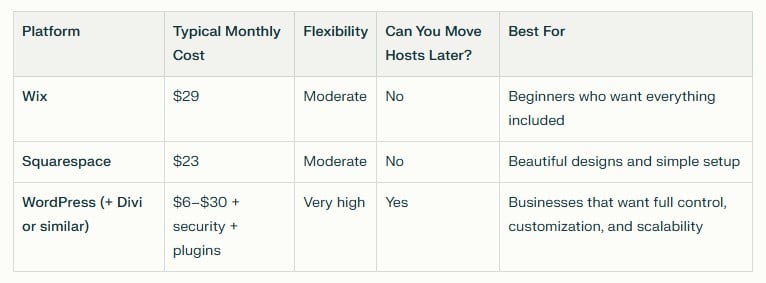
WordPress has a steeper learning curve but wins on ownership, portability, and advanced optimization options, which is important if SEO or AI visibility matters to your business. WordPress is my choice because of the flexibility in terms of features and the fact that I can move a website from one host to another pretty easily. I don’t like the idea of being locked into a proprietary hosting service.
5 Hidden website costs pet sitters often miss
Looking only at the upfront price can lead to expensive mistakes later. These factors have a big impact on performance and budget:
SEO & AEO setup
Without structured content, fast loading, and search-intent optimization, even a pretty site may never rank or show in assistant answers. And, make no mistake, even with AI on the rise, SEO is still very important. It provides a solid foundation that works along with AEO.
Portability and ownership
Wix and Squarespace don’t let you export your full site design. If you decide you want to move away from either of them, you will need to start from the very beginning. With WordPress, you’re able to download your complete website and upload it to a new hosting company. Oftentimes this is a fairly quick procedure, especially for smaller websites.
Performance
Page speed, caching, and image optimization affect both visibility and user experience. With Wix and Squarespace you have little control over this, as they manage most of it for you. WordPress gives you a lot more flexibility, but you will need plugins like WP-Rocket to optimize your website.
Maintenance & support
Platforms like Wix and Squarespace take care of all technical maintenance and provide support. With WordPress, you choose your host, tools, and support level. And, if you’re working with closely with your web designer, it means you’ll get personal support from someone who knows you and your website.
Time & strategy
DIY can be extremely overwhelming for small business owners who have never built a website before. A designer can guide you along the way with content ideas, how to structure your website so it’s appealing – and easy to navigate. And, a good designer will also be able to optimize your website for SEO and AEO — all while you’re working on other aspects of your business.

Ongoing website costs to plan for
Regardless of which platform you choose, you’ll want to plan for some ongoing costs so there are no surprises later:
- Domain registration: yearly
- Hosting (WordPress): monthly or yearly
- Security & backups (WordPress): Some hosting companies will include this. The service I use and recommend is about $90/year
- Plugins or tools: optional, depending on features. Many of the plugins I use for my clients are free.
- SEO or AEO support: this is extremely important if you want to be seen in regular searches as well as AI
- Content updates: this would include pricing changes, new services, blogging, and any other ongoing changes. And just a little FYI, old-fashioned search engines like Google and AI (ChatGPT, Perplexity, Google AI, etc.) like to see updates!
Why work with a designer who knows the pet industry?
A designer who hasn’t worked in the pet industry may not understand the differences in pet sitting services like drop-in visits, dog walking, and overnight care. I’ve seen a lot of websites that were built by people who didn’t know the industry. and, not surprisingly, I’ve had clients come to me for a website redesign after using someone like this. They realized the website didn’t accurately reflect what they did, and came to me specifically because I’ve owned my own pet sitting business. It makes a difference!
A designer who has actually run a pet sitting business understands how clients search, what they worry about, and what makes them feel safe enough to book. That knowledge shapes design, layout, and messaging so your site ranks and brings in new clients.
Example pet sitter sites in competitive markets:
Peace Love Paws Pet Sitters – Columbia, MO
Just Around the Corner Pet Sitting – Plymouth, MA
How long does it take to build a website?
If you’re going the DIY route, that’s entirely up to you! I’ve seen people whip up a website in a matter of hours. Other people I’ve talked to have told me it took them months to figure things out and get their website built.
If you’re working with a professional web designer, the time range can vary widely. Most of my projects take about 4–6 weeks. The actual time will depend on whether or not you have your content ready, how quickly you respond to requests, and the number of revisions. Rush projects may be possible but it’s possible there will be an added cost depending the timeline.
FAQ: pet sitting website design costs
How much should a pet sitter budget for a website in 2026?
Most pet sitters budget $2,000–$3,000 for a professionally built starter website with basic SEO and AEO setup. For large websites with multiple pages, features, and advanced SEO and AEO you can expect to pay more. DIY options like Wix or Squarespace cost less monthly but are limited in what you can do. WordPress is a lot more flexible and enables better long-term SEO and AEO potential.
Can I start with Wix or Squarespace and move later?
You can, but remember . . . those platforms don’t let you export your full site. So if you want to move later you’ll be starting from scratch. If you think you’ll want more flexibility later, starting on WordPress can save you time and money.
Do I need ongoing SEO or AEO?
Yes. Ongoing optimization helps your site keep showing up when pet owners search and when they ask AI assistants to recommend local pet sitters. And now, especially, with AI changing day by day it’s important to pay attention and be able to make changes when needed.
To Sum it All Up
A professional pet sitting website typically costs between $2,000 and $5,000. DIY options like Wix or Squarespace cost less upfront but limit flexibility, ownership, and SEO potential. WordPress offers the best long-term value for growth, performance, and visibility in both search and AI assistants.
A website for your pet business isn’t just a digital brochure, it’s often the first impression your business makes. Whether you DIY or hire a designer, focus on creating a trustworthy, well-structured, and optimized site that is search engine and AI friendly, and helps pet owners feel confident booking you.
Ready to talk about options for building your pet care business website? See my web design info page or send me a message and let’s talk!
STRUGGLING WITH YOUR WEBSITE?
Learn how to structure the content on your website to attract more of your ideal clients.
The Website Content & SEO Blueprint gives you a clear plan for what to say, where to say it, and how to make sure search engines (and humans) find you.
What a great set of information to either get started or re-galvanize online efforts! Thanks for doing this….
It triggered some ahha moments for me.
Remind yourself – creating a site isn’t one and done. You can add and tweak – and should. It is a living breathing part of your business. It works for you 24 hours daily.
Maybe use placeholders while you are deciding a policy or still haven’t come to closure on something. Otherwise, you don’t have this valuable document working for you.
Also, take an hour or so to review websites of people operating in your service area.
SEO is sooooooooooooooooo critical. Get a simple working knowledge of it and nurture those elements. It will pay off! If you understand the basics… you will rise to the top 5 very easily.
Always be on the look out for photos that are compelling. Make you smile. Get the point across.
Having a rich resource section can draw people to you and teach you along the way.
If you are developing a logo at this point. Don’t ask your friends and family or other pet sitters for there opinions – ask your target clientele for their opinions. I id’d my logo through a contest website… it wasn’t my favorite. I liked it, BUT…. Four of my clients who fell into my demographic focused me on it. They said it profiled happy pets happy to see me. When I went to cats only – I went back to my designer and we adapted to all cats. It was an arranged marriage and I learned to love it! Fell deeply in love with it.
There are free websites that will check your site for broken links – do it at least once weekly – it is well worth the time.
Therese really knows her stuff. She has been in this business for a long time and has a huge portfolio of knowledge and expertise. Do now hesitate and run towards her. I also think she would be great to create non-pet sitting sites.
********
I started with a site similar to WIX and moved to a larger company that used Word Press. It worked well at first, by a fluke. Their designer was leaving the company and I was the last site she did. I had already self-transferred all of my blog entries. She wasn’t going to get it all finished and they had screwed around on me. She gave me a tutorial on how to build pages – about 20 minutes. I developed a very content rich site where I built everything except maps. I found working with their people was very difficult but had taught myself some basics and also just enough understanding about SEO to move me to the top in most keyword areas.
I had to leave the field due to ill health and really miss the interaction with the pets, clients and the resource section of my website.
P.S. Also use build something like a Pinterest site to make referral of basics for your clients. I found lost pet information, guidance on finding a good vet and concierge pets helpful, low cost spaying or neutering along with dental care – extractions, helping community animals, and grief and the passing of pets were all great draws to my page. Pinterest resources that were very popular were – litter boxes in small spaces (DC is lots of apts.), DIY toys, ideas for feeding stations or food storage places.
As Miracle Max said, in The Princess Bride, “Have fun storming the Castle.”
Hey, Jonann! It’s so good to hear from you.
Thanks for adding so much good info. I especially like the idea of asking your clientele for opinions – after all, you’re catering to them!
And thank you for the kind comments. I love what I do, and positive feedback makes it all the sweeter!